
How to throw a Boxing Hook: The Complete Masterclass for Speed, Power, and Precision
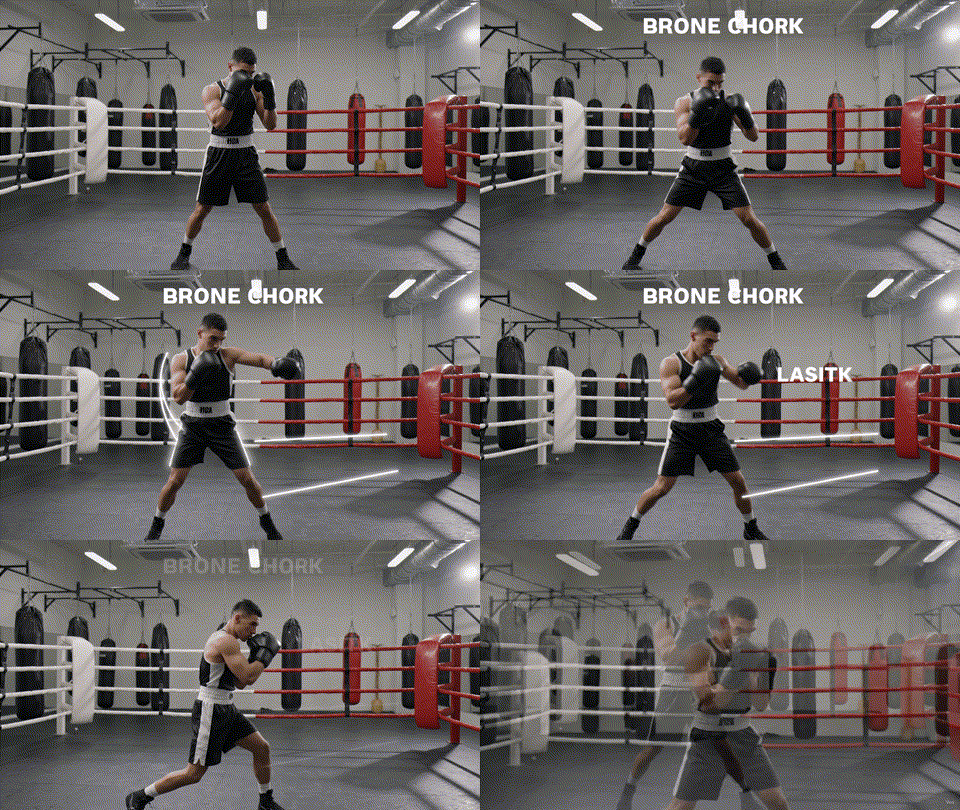
In the sweet science of boxing, few weapons command as much respect and raw awe as a perfectly executed hook. It is the signature punch of legends like Mike Tyson and Joe Frazier a looping, devastating strike that bypasses an opponent's straight guard to land flush on the jaw or ribs. However, learning how to do boxing hook is one of the most mechanically complex tasks for beginners and intermediates alike. It is a striking pattern that requires complete synchronization of your entire body, transforming a simple rotation into a whipping force that can end a fight in a split second.
If you have ever felt your wrist buckle on the heavy bag, found yourself off-balance after throwing, or felt like your punches lack authentic "pop," the issue lies within your foundational mechanics. Throwing a high-impact hook is not about sheer upper-body strength; it is an athletic movement requiring absolute mechanical alignment. This comprehensive masterclass on Boxing Essential will deconstruct the anatomy of the hook from the ground up, highlighting critical technical nuances that even established competitors often overlook.
KEY TAKEAWAYS
- Power Comes from the Ground: The hook is not an arm punch. True force initiates from your feet, rotates through the hips, and transfers along the kinetic chain into your knuckles.
- Nail the 90-Degree Angle: Maintain a rigid 90-degree bend at the elbow during impact to protect your shoulder joint and deliver maximum structural integrity.
- Protect Your Jaw: Never drop your non-punching guard hand. Your opposite glove must remain glued to your temple to defend against devastating counterstrikes.
- Understand the Ranges: Choose a "thumb-up" hand position for tight, close-range combat, and switch to a "thumb-down" orientation to maintain alignment at mid-to-long ranges.
The Physics of Power: Understanding the Kinetic Chain
To throw a hook that shatters guards and carries authentic knockout power, you must first dismantle the myth of the "arm punch." If you rely solely on your shoulder and bicep to swing
your arm, your hook will be slow, easily telegraphed, and structurally weak. Highly effective punching relies entirely on executing an unbroken flow of energy, known in sports science as the kinetic chain. To optimize this flow, force must be transmitted from the floor, through the legs and core, and finally projected out of the fist.
According to academic studies on kinetic chain power, maximum rotational force is achieved when the lower body rotates ahead of the upper torso, creating a stretch-shortening cycle in the core musculature. This means your feet and hips initiate the rotation, twisting your torso like a coiled spring. Your arm simply acts as a rigid conduit that delivers this stored kinetic energy directly to your target. By focusing on hip and heel rotation rather than arm swing, you immediately double your impact force while minimizing the risk of shoulder strain.
Pro Tip: Think of your arm as a heavy metal wrecking ball and your core as the heavy crane rotating it. The crane (torso) does all the heavy swinging; the wrecking ball (your fist) simply goes along for the ride, maintaining its rigid shape until impact.
How to Do Boxing Hook Setting the Perfect Foundation
Before you release a punch, your starting position determines whether your strike succeeds or fails. To master how to do boxing hook, you must establish a balanced, defensive-minded boxer's stance. This structural position provides the necessary leverage to shift weight quickly, maintain your center of gravity, and return to safety if your punch misses its mark.
Step 1: Anchor Your Fighter's Stance
- Foot Placement: Stand with your feet shoulder-width apart. If you are right-handed (Orthodox), take a step back with your right foot. If you are left-handed (Southpaw), take a step back with your left foot. Your feet should be angled slightly outward to allow rapid lateral rotation.
- Weight Distribution: Distribute your weight evenly (50/50) on the balls of both feet. Keep your knees softly bent and your center of gravity low. Never stand flat-footed, as this arrests your hip mobility.
- The Guard: Keep both elbows tucked tightly against your ribs to protect your liver and spleen. Elevate your gloves, positioning your dominant hand against your cheek and your lead hand slightly forward, shielding your temple. Keep your chin tucked low into your collarbone.
Step 2: Load the Kinetic Spring
To throw a powerful lead hook, you must briefly "load" your weight. Transfer roughly 60% of your body weight onto your lead foot. This subtle weight shift cocks your hips, preparing your lead side to rotate with explosive force. Be careful not to lean forward too aggressively
head should remain centered, avoiding any obvious tell-tale signs that telegraph your attack to an alert opponent.
Step 3: Pivot, Rotate, and Drive
- The Pivot: Explosively pivot your front foot inward, turning your heel outward as if squashing an insect on the floor. This single movement drives your knee and hip inward, initiating the rotation.
- The Torso Twist: As your hip rotates, let your shoulders and chest rotate along the same plane. Your lead shoulder should snap forward while your rear shoulder pulls back slightly, maximizing torque.
- Arm Alignment: Simultaneously raise your lead elbow so that your upper arm is completely parallel to the ground. Maintain a strict 90-degree bend at your elbow joint. Keep your wrist locked and perfectly straight to prevent wrist buckling.
- The Impact: Land your punch with the front two knuckles of your fist. At the moment of impact, contract your bicep and shoulder to lock your arm shape, transferring the full weight of your rotating body into the target.
Step 4: Snap Back to Guard
The moment your hook lands or reaches its target area, snap your hand straight back to your face along the same path it traveled. A common amateur mistake is allowing the punching hand to drop to the waist after throwing. This exposes your chin, leaving you vulnerable to a counter cross. Always return to a high defensive guard immediately.
Comparing the Lead Hook and the Rear Hook
While both punches are devastating, the lead hook and the rear hook serve entirely different strategic purposes and rely on distinct mechanical variations. Understanding these differences is essential for adding variety to your combinations and controlling distance in the ring.
How to Do Boxing Hook 3
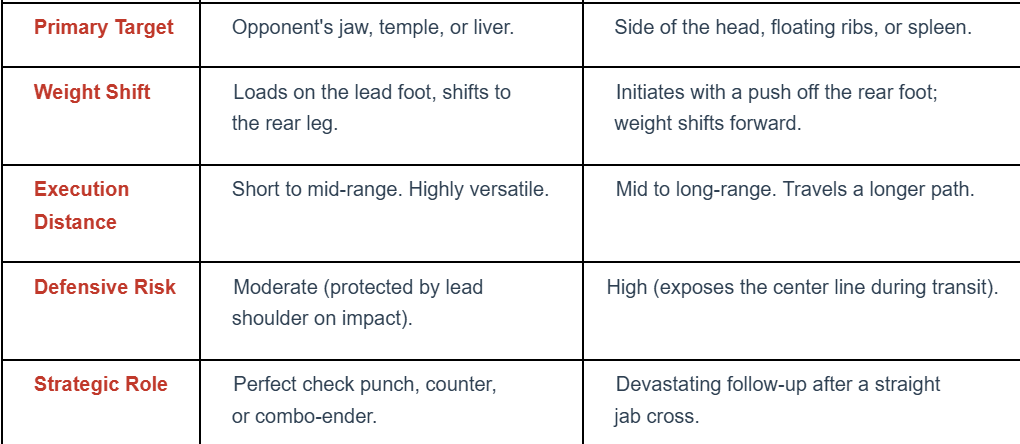
As outlined in Peloton's fundamental striking guides, the lead hook remains one of the hardest punches to master because it is thrown from your forward side, meaning you have less natural distance to build up speed. However, because it originates closer to your opponent, it is incredibly fast and difficult to defend against when executed correctly.
Conversely, the rear hook requires significant rotation from your back side. In his analysis on highly practical boxing tips, Coach Fran emphasizes that the rear hook must travel a longer path, meaning it is easily telegraphed if thrown without setup. To land a rear hook cleanly, you must first distract your opponent with straight punches, forcing their guard to narrow before swinging around their defense.
The Great Debate Thumb Up vs. Thumb Down Hook
Among boxing coaches and fighters, few technical discussions generate as much debate as the orientation of your fist upon impact. Should you throw your hook with your thumb pointing up (vertical fist) or with your thumb pointing toward you (horizontal fist, palm down)?
1. The Thumb-Up Hook (Vertical Fist)
Often favored by North American coaches and close-range inside fighters, throwing a hook with your thumb pointing toward the ceiling is highly effective for close-quarters fighting.
- The Benefits: This hand position keeps your wrist naturally aligned with your forearm, reducing joint stress when hitting a heavy bag or an opponent's hard skull. It is also easier to sneak through tight vertical gaps in a high-guard defense.
- The Limitations: This punch is difficult to land effectively at mid-to-long ranges because extending your arm while keeping your thumb up can cause you to hit with your inside fingers, resulting in slapping punches or hand injuries.
2. The Thumb-Down Hook (Horizontal Fist)
Traditionally taught in European and Eastern European amateur boxing systems, this variation requires you to rotate your wrist so that your palm faces the floor upon impact.
- The Benefits: Rotating your palm downward naturally raises your punching shoulder, which provides excellent defensive protection for your chin. This orientation is highly effective for mid-to-long-range hooks, ensuring your front knuckles land flat against the target.
- The Limitations: It requires excellent wrist strength. If your wrist is loose or bent on impact, you risk a boxer's fracture or sprain.
- Technical Rule of Thumb: Use "thumb-up" when you are fighting close enough to smell your opponent's breath. Use "thumb-down" when you are fighting at mid-to-long range and need your knuckles to land flush on the target without slapping.
Advanced Tactics Targeting the Body and Level Changing
A predictable head-hunter is easy to defend against. To elevate your game, you must learn to change levels and target the body with your hooks. Body hooks are incredibly painful, exhausting, and can easily end a fight by targeting the liver on your opponent's right side.
To throw an effective body hook, you must avoid simply punching downward. Doing so exposes your head to counters. Instead, bend your knees and drop your entire hips to match the level of your target. Your forearm should remain parallel to the ground or angle slightly upward, driving the punch up and under your opponent's ribcage. As detailed in FightCamp's lead hook training tutorials, changing levels before throwing a hook lets you use your leg muscles to drive the punch, creating a deep, piercing impact that drains your opponent's cardio.
Common Mistakes That Ruin Your Hook (and How to Fix Them)
Even experienced boxers can slip into bad habits that limit their power and expose them to dangerous counters. Watch out for these four common technical errors:
- Telegraphing (Drawing Back): Many fighters try to punch too hard by pulling their hand back before throwing. This "wind-up" alerts your opponent, giving them plenty of time to slip or counter. Keep your hand strictly on your cheek until the rotation of your hips throws it forward.
- Flaring the Elbow Too Early: If you raise your elbow before initiating your hip rotation, you lose the power of the kinetic chain and advertise your intent. Your elbow should rise in unison with your hip pivot, not before.
- Dropping the Opposite Guard: When throwing a lead hook, do not let your rear hand drift down to your chest. Keep your rear glove glued to your temple. A dropped guard is an invitation for a counter-hook or cross.
- Slapping: If your elbow is bent at an angle wider than 90 degrees or your wrist is loose, you will slap the target with the inside of your glove rather than striking with your knuckles. This can cause wrist injuries and lacks impact. Keep your arm rigid on impact.
Conclusion
Mastering how to do boxing hook is a defining milestone in any boxer's development. It is a punch that rewards patience, precise body alignment, and consistent practice over raw physical strength.
By focusing on your kinetic chain, maintaining a rigid 90-degree elbow shape, choosing the correct fist orientation for your range, and keeping your guard high, you can develop a hook that is both powerful and defensively sound.
The best way to refine this punch is through slow, deliberate practice. Stand in front of a mirror and analyze your foot pivot, hip rotation, and hand positioning.
Once your form is consistent, transition to shadowboxing, light heavy bag work, and eventually controlled sparring. With time and dedication, this punch will become an instinctive, devastating asset in your athletic arsenal. Keep your hands up, stay dedicated, and let your body drive your power.
Frequently Asked Questions
Q:Is it better to throw a hook with palm-in or palm-down?
Neither is objectively better; it depends on your range. For close-range exchanges, throwing with your palm facing in (thumb-up) is safer for your wrist and easier to land. For mid-to-long-range hooks, throwing palm-down (thumb-down) is superior, as it raises your shoulder to protect your chin and ensures your knuckles make clean contact.
Q:How do I stop my wrist from hurting when throwing hooks on a heavy bag?
First, ensure you are wearing high-quality hand wraps and boxing gloves with proper wrist support. Second, check your alignment: your wrist must be straight and locked, never bent. Finally, ensure your elbow is directly behind your fist on impact. If your elbow is too low, it forces your wrist to bend, leading to joint strain.
Q:How can I increase the power of my lead hook?
Power does not come from your arm; it comes from your legs and hips. Focus on pivoting your lead foot explosively, which turns your hip and drives your weight through the punch. You can also increase power by slipping to your lead side before throwing, which "loads" your lead leg with elastic energy.
Q:Can I throw a hook from a long distance?
Yes, you can throw a long-range hook (often called a "whip hook" or Russian hook). This strike requires you to rotate your palm down and use a wider, shallow arc to reach around your opponent's straight guard. However, keep these tight and compact, as wide punches are easier to counter.
Related Articles
 Boxing Training
Top 11 Best Boxing Gyms in Sunnyvale, CA for Training
Finding the Best Boxing Gyms in Sunnyvale can be a game-changer for your fitness journey. Whether you’re aiming to learn self-defense, improve endurance, or train like a professional fighter, Sunnyvale offers several high-quality boxing gyms equipped with experienced coaches and modern facilities.
 Boxing Training
Top 11 Best Boxing Gyms in Stockton, CA for Training
Finding the Best Boxing Gyms in Stockton can completely transform your fitness routine, self-defense skills, and overall health. Stockton, California has developed a strong boxing culture with gyms that cater to beginners, amateur fighters, and professional athletes.
 Boxing Training
Top 10 Best Boxing Gyms in South San Francisco, CA Guide
Boxing has become one of the fastest-growing fitness trends in the United States. It’s no longer limited to professional fighters; people of all fitness levels now use boxing workouts to improve strength, endurance, and mental focus.